Most enterprise software sold to the federal government is still priced per seat. An agency pays the same annual fee for an approver who logs in once a quarter as for an analyst who works in the system all day. This paper explains the alternative, consumption-based pricing, why defense and civilian buyers are asking for it, and what to check in a vendor’s contract before you sign.
Spending differently, with the same budget
The Department of Defense has to modernize against new threats while Congress looks harder at every line of the budget. There is broad agreement in both parties that defense capability matters, and equally broad agreement that the services will have to spend their money differently to get it.[1] Representative Ken Calvert, speaking as chairman of the House Appropriations Subcommittee on Defense, described the mood plainly: “There are going to be some unhappy people who are all trying to get their two cents in, but we don’t have two cents.”[2] Other congressional leaders have said the same thing in their own words: the Pentagon has to get more out of each dollar it already has.[3]
Software buying is one place where that is already happening. In the early 2000s agencies stopped buying and installing software on their own servers and started subscribing to software as a service. A second shift is now under way, from paying per user or per seat to paying for what is actually used.
The idea is old and simple. People already pay for electricity by the meter and fuel by the gallon, and software vendors began offering usage-based pricing on the same logic roughly ten years ago.[4] Bain & Company’s 2022 technology report called consumption pricing “the model fueling some of the fastest-growing and highest-valued SaaS companies,” and found that 80% of customers on consumption pricing report better alignment with the value they receive.[5] Vendors across the market have been moving away from per-user schemes toward more flexible ways to buy.[6]
Federal buyers see the same advantages. When a contract rewards use instead of seat counts, a program office can give software to everyone who needs it, start small and pay more only when the system is earning its keep.
Two pricing models, defined
Both models usually sit on top of other costs. Enterprise SaaS vendors often charge a base or platform fee in addition to seats or usage, and most platforms need professional services for integration, configuration and training, delivered by the vendor or by a partner. The comparison below is about the part of the bill that grows as the program grows.
License-based pricing (per user, per seat)
The cost of the software depends on how many people in the organization need access. Each user is assigned an individual license that grants the right to use the software on the vendor’s terms, and the organization pays a recurring subscription fee for each one.
The cost per user per year is fixed. A user who logs in once a quarter costs exactly as much as one who works in the system every day. That arrangement suits the vendor far better than it suits a government or military buyer.
Many enterprise vendors add tiers on top. Prices vary by user type (approver, fulfiller, administrator) and by feature package (names like Essentials, Professional and Enterprise). These tiers are tied to feature sets inside the platform, and they are hard to compare or quantify from the outside.
Consumption-based pricing (usage-based, utility-based, metered)
The customer pays for actual use of the software’s resources or features. Depending on the vendor, use is measured as API calls, workflows run, storage, data processed or time in use, at rates or tiers the vendor sets in advance.
The appeal is flexibility. An organization pays for what it uses, so spending tracks need, and nobody pays for idle capacity. That matters most to agencies whose workload rises and falls with the fiscal year, an exercise cycle or an emergency.
Consumption pricing is payment for actual use, where a seat license is payment for the right to use. If the vendor earns more when the software is used more, the vendor has a reason to help the agency drive adoption and use, and every bit of that use is benefit the agency receives. Because there is no limit on users, anyone who would benefit can be given access at no added cost. And the bill itself shows how much was used and what each unit cost.
| Question | Per-seat licensing | Consumption-based |
|---|---|---|
| What you pay for | Number and access level of seats | Volume of use |
| Who can use it | Every user consumes a license | Unlimited users |
| Cost per user | Fixed, whether the user logs in or not | Varies with how much each person uses |
| Price structure | Often complex: tiers, packages and license types | Units consumed times a known rate |
| Monthly cost | Fixed and predictable, and usually higher | Variable, and usually lower |
| Features | Set by user tier or access level | Limited only by the user’s security role |
| Slow periods | Hard to scale down | Cost falls with use |
| Vendor incentive | Sell more licenses | Get the software used more |
Predictability in theory and in practice
On paper, per-seat pricing is the more predictable of the two and usage pricing is the simpler. In practice, large vendors that price by seat often have models complicated enough that the real cost is hard to understand in advance.
ServiceNow is a common example. One implementation partner describes its pricing as “a complex matrix of factors where each factor weighs in to influence your grand total.” Price varies by industry, region, organization size and product, and “each product offers at least two packages where this general rule applies: the more functionality available, the bigger the price. On top of that, your total price is affected by the number and type of licenses” the customer needs.[7] A program office can know its seat count exactly and still struggle to forecast next year’s bill.
Why per-seat licensing costs the DoD more than it should
The DoD spends more than $45 billion a year on IT, communications, infrastructure and business systems, according to GAO’s annual assessment of its IT programs.[8] Congress has questioned whether that money is well spent. In 2022 the House Armed Services subcommittee responsible for cyber and information systems called for an independent assessment of how much the department loses, including in lost productivity, to poorly performing software and IT.
A committee aide described what that looks like for the people in uniform: “Because the department and the military services often have what we consider underperforming, poorly performing software and IT, service members are wasting an enormous amount of their time which is not spent training. It’s not spent thinking strategically. It’s not spent doing the things that we need them to do as a military because they’re literally staring, waiting at their computer for their computer to load, for their email to load, for one system to talk to another.”[9]
Per-seat licensing adds to the problem in two ways. It makes software more expensive to give to the people who need it, and it creates a management burden the department has never fully solved.
A license management gap that has been open for a decade
In 2014, GAO found that “the Office of Management and Budget (OMB) and the vast majority of agencies that GAO reviewed,” the DoD among them, “do not have adequate policies for managing software licenses.” The DoD added webinars and video training in the years that followed. In 2019 it was still working “with peer agencies to identify opportunities to access required software management skills and other required training.”[10]
Seat licensing has been good business for vendors. Prices are complex, as the example above shows, and the money is paid up front for value that arrives over time. An organization that wants to avoid overspending can run a license management program, but those programs are complicated, expensive and slow. Many organizations conclude that buying extra seats is simpler and cheaper than tracking them closely or risking being out of compliance.
Vendors know this. One industry publication warned that, facing declining revenue, “vendors are relying on audits to make up for lost revenue and consolidation in the industry. Expect certain vendors to aggressively increase their efforts to ensure license compliance. Non-compliance can carry hefty penalties.” It added that customers once had “no other recourse but to buy in bundles,” and that cloud offerings and premium features “have become increasingly complex. This means overcharging may run rampant.”[11]
Under per-seat licensing, every path costs the agency money
Option 1
Buy more seats than you need
Simple to administer. The agency pays every year for seats nobody uses, including users who are licensed but not yet trained.
Option 2
Manage every seat closely
Fewer wasted seats. The agency pays instead for license management staff, tools and the time spent matching users to tiers.
Option 3
Under-manage and hope
Cheapest until the vendor audits. Being found out of compliance can bring penalties far larger than the seats would have cost.
Consumption pricing removes the seat count, so none of the three applies.
Over-buying seats is expensive and wasteful. Managing seats closely enough to avoid over-buying is also expensive and wasteful. Being found out of compliance in an audit can be the most expensive of all. And under every per-user model, the organization pays for people who have a license but have not yet been trained or started using the software.
There is a quieter cost too. When seats are rationed, people who need a system and cannot get a license find another way to do the work: a spreadsheet, a shared mailbox, a tool bought on a card. Those workarounds sit outside the agency’s processes and data, and they are hard to see until something goes wrong.
Paying by use avoids all of this. Spend is tied to work done from the first day of a program, which is why defense buyers are steering more procurement toward vendors that offer it.
Thirteen advantages of consumption-based pricing
Demand and supply are moving in the same direction. On the supply side, four of the seven fastest-growing enterprise software vendors price mainly on consumption, according to Bain. On the demand side, Bain found that consumption pricing “has quickly become popular with customers. With consumption pricing, 80% of customers report better alignment with the value they receive. Nearly half of software companies using it say it has helped them acquire more customers.”[12]
For the military and federal civilian agencies, moving from per-seat to pay-for-what-you-use reduces unused software and gets value to users sooner. The thirteen reasons below are grouped by who in a program office feels them first.
Cost and budget
1. Flexibility and scale. Under per-user pricing, costs go up as licenses are bought and rarely come back down. Under consumption pricing, cost rises automatically during heavy use, with no extra seats to buy, and falls during slow periods.
2. Cost efficiency. You pay for what you use, the way you pay for electricity or cloud storage. Per-seat licensing is less efficient by design. As an earlier Kinetic Data article put it, “Managing the costs incurred by per-user licenses can be a tricky undertaking. That’s why organizations need to be careful to ensure they are striking the right balance between covering their usage needs and not overspending. Keep in mind that vendors depend on your inefficiencies to increase license counts.”[13]
3. Lower upfront cost. Under either model, most enterprise systems carry a flat platform fee and professional services at the start. Beyond that, the difference can be large. License-based contracts usually require a minimum number of licenses bought up front and “consumed” over time. Consumption-based costs are close to zero at implementation and rise as use grows.
4. Cost tracks value. A per-seat contract charges the same for a casual user as for a power user, so cost and value drift apart. With consumption pricing, the agency pays for the units each person actually uses.
5. A fairer deal. Consumption pricing ties the agency’s spending more closely to what it costs the vendor to serve it. Seat licensing is a good deal for vendors and a poor match between what buyers pay and what they get. Frank Slootman, who ran ServiceNow and later Snowflake, said of his ServiceNow years: “I always felt there was an inherent inequity between us as a vendor and the customer. The customer would often buy tons of licenses, and they wouldn’t even be using them yet. And I’m like, ‘This isn’t right. This is not equitable.’”[18]
Access for users
6. More people can use it. There is no reason to cap the number of users or make new users justify a seat. One venture capital firm made the point to vendors: “Abandoning seat-based software pricing models encourages more people within a customer account to incorporate your product into their workflows and processes.”[14]
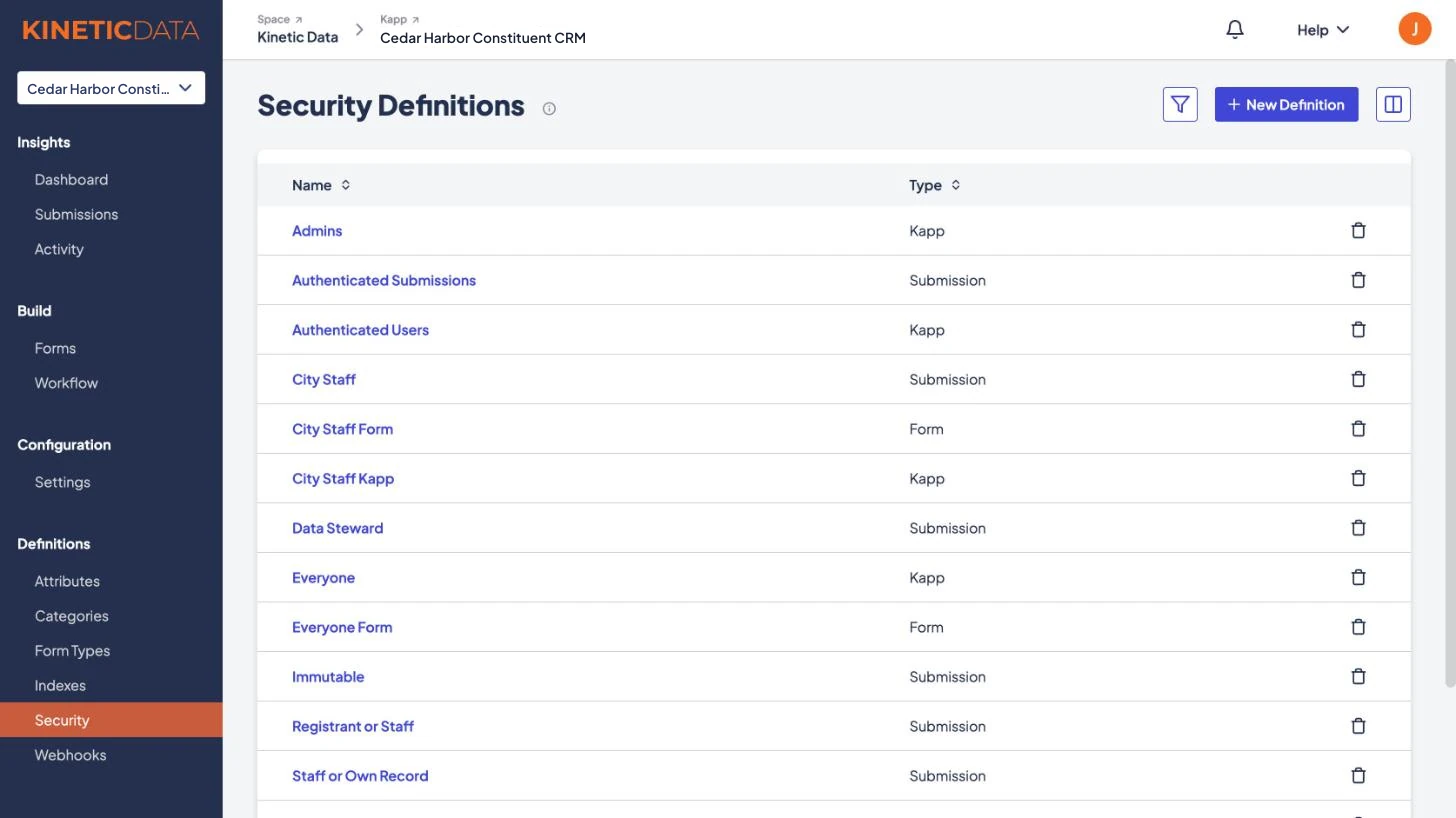
7. Every feature for every user. Per-seat vendors usually price user types in tiers, with more functionality for power users at a higher price. Someone then has to match each new user to the right tier, balancing what they need against what it costs. With consumption pricing every user gets every feature. The only limits are security-based access rights, so the agency gets more from the software and spends less time administering it.
8. Happier users. Users get the whole product without having to argue for a better seat, and they get a system built for their work without features they never asked for.[17]
9. Less bloatware. Large enterprise systems often come bundled with products and features nobody needs or requested, which are hard to remove and confuse users.[16] A purpose-built system priced on consumption gives users what they need and leaves the rest out.
Administration and risk
10. Simpler management. As with a utility, the bill follows use. There is no license management system to buy and no process to run around it.
11. Lower risk. With no seat count, there is no risk of overspending on licenses and no compliance audit with financial penalties attached.
12. Clear, transparent bills. Usage is easy to monitor. Whatever the unit (API calls, database queries, transactions or workflows), the quantity consumed is easy to track and the price per unit is known. Enterprise license models, by contrast, are often complex, granular and opaque.
Speed
13. Faster time to value. License-based systems often start with a large payment and deliver value gradually. Consumption-based costs usually start low and rise with use. OpenView, writing for software vendors, described the effect: “It allows the customer to start at a low cost, minimizing friction to adoption. The best way to win customers in the end-user era is to deliver value rapidly and for little to no cost… usage-based pricing is extremely customer-friendly.”[15]
Who prices this way
Buyers and vendors are both adopting consumption pricing. Bain’s research found that, among software companies using it, “nearly half… say it has helped them acquire more customers, and two-thirds say it’s helping them increase revenue with existing customers.” It is the main pricing model at four of the seven fastest-growing enterprise software companies.[19]
Well-known vendors that price some or all of their products on consumption include Amazon Web Services, Snowflake, Datadog, Twilio, MongoDB, Confluent, Dynatrace, Avalara and JFrog. Kinetic Data prices the same way, as described below.
Questions to ask a vendor before you buy
A vendor that offers usage pricing can still write a contract that behaves like seat licensing. These questions, drawn from the arguments above, help a contracting officer or program manager tell the difference.
Pricing checklist for an enterprise software purchase
- What is the billing unit? API calls, workflows, transactions or storage. Ask how it is counted and whether you can see the count yourself, at any time.
- Is any part of the price tied to named users? A small “per active user” charge brings back the seat count and the audit exposure that comes with it.
- Are features split into tiers by user type? If approvers, fulfillers and administrators get different features at different prices, someone in your office will spend time assigning them.
- What is fixed and what varies? Separate the platform fee and professional services from the usage charge, so you know which part of the bill follows use.
- Is there a minimum commitment? A large minimum works like an up-front seat purchase. Ask what happens to unused volume at the end of the term.
- Does the rate fall as volume grows? Usage pricing should reward broad adoption, which is the outcome the agency wants.
- What does the contract say about audits? With no seat count there should be little to audit. Check for true-up clauses anyway.
- Does the price change with where it runs? Vendor cloud, your own cloud account, an on-premises data center or an air-gapped network can each carry different fees.
How Kinetic is priced
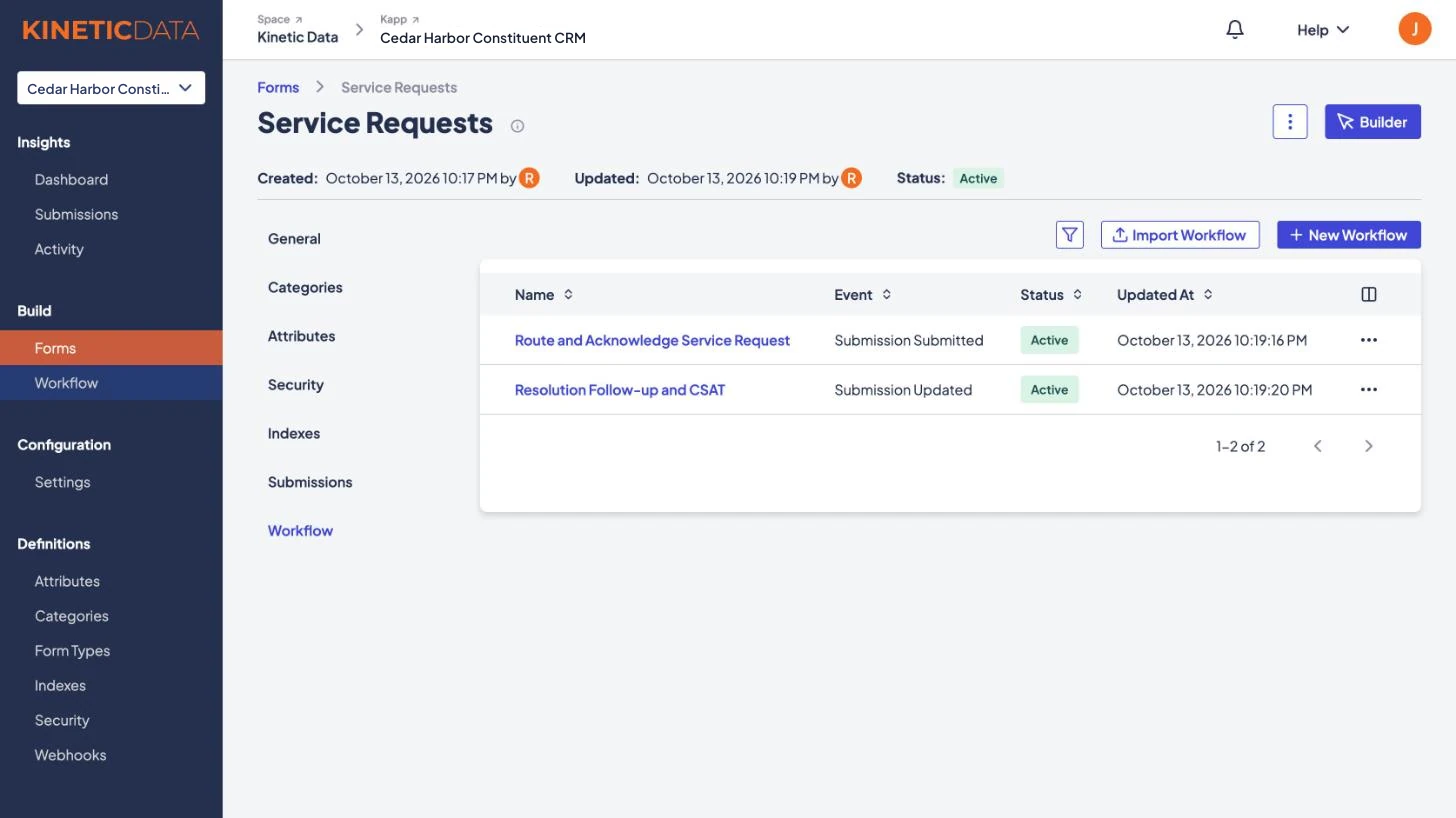
Kinetic Data does not charge per user. Kinetic is licensed as a platform subscription plus consumption, and consumption is measured in workflows run. A workflow counts when it starts, whether a person submits a form, a system sends an event or a schedule fires, and the rate per workflow falls as volume grows. Opening a portal to 9,000 people needs no more licenses than opening it to 90. The Missile Defense Agency runs approval and routing workflows for more than 9,000 users on Kinetic, and has cut routing cycles from five days to about two (read the MDA case study).
We do not publish prices, because a department running one portal in our cloud and an agency running twenty applications on its own air-gapped network need very different agreements. Kinetic runs as a Kinetic-hosted cloud service or as a customer-managed installation, including air-gapped networks, and it is deployed today in DoD IL4 and IL5 customer environments. Community Edition is free for developers and non-production evaluation. AI model costs do not come from Kinetic: agencies bring their own model, such as Anthropic Claude, Amazon Bedrock, Azure OpenAI or a self-hosted model, under their own agreement.
See how Kinetic pricing works for the editions and add-ons, or read about Kinetic for federal and defense programs.
Conclusion
The military and federal agencies are being asked to get more from technology while spending less on the infrastructure and applications behind it. Changing how they pay for enterprise software is one of the more practical ways to do that.
Private-sector buyers have been moving to consumption pricing for about a decade.[4] With it, the DoD and federal agencies pay for the value they get from software instead of buying more licenses each time their needs change. The benefits are concrete: flexibility and scale, simpler administration, less audit risk, lower upfront cost, faster time to value and more satisfied users. Vendors have noticed, and consumption is now the main model at four of the seven fastest-growing companies in enterprise software.
“Buy more licenses” is no longer the default answer to every new requirement. Software decision makers across the military and civilian agencies are following the private sector toward pricing that gets software into users’ hands sooner and ties cost to the value it returns.
To see how a usage-priced platform would fit one of your own processes, book a working session. It is a free two-hour session that maps one process across the systems it touches and ends with a written plan.
About Kinetic Data
Kinetic Data is the build platform for AI-enabled business. Its Kinetic platform lets organizations build applications, workflows and agent-ready processes on top of the systems they already own, with AI generating the experiences and workflows and people and agents working in the same process.
Founded in 1998, Kinetic Data has spent more than 25 years building software for large organizations and 20+ years serving defense and intelligence customers.
Sources
- “Innovation Exchange Lab opens virtual doors to enable more rapid Army modernization,” U.S. Army. https://www.army.mil/article/275130/innovation_exchange_lab_opens_virtual_doors_to_enable_more_rapid_army_modernization
- The Hugh Hewitt Show, podcast transcript. https://podcasts.apple.com/us/podcast/the-hugh-hewitt-show-highly-concentrated/id1517313007
- Hugh Hewitt Podcast, “Speaker Kevin McCarthy and Governor Ron DeSantis,” podcast transcript, Salem Podcast Network. https://salempodcastnetwork.com/podcasts/hugh-hewitt-podcast/speaker-kevin-mccarthy-and-governor-ron-desantis-t
- “The Rapid Rise of Consumption-Based Licensing Models,” Revenera. https://www.revenera.com/blog/software-monetization/the-rapid-rise-of-consumption-based-licensing-models/
- “Is Consumption-Based Pricing Right for Your Software?,” Technology Report 2022, Bain & Company. https://www.bain.com/insights/is-consumption-based-pricing-right-for-your-software-tech-report-2022/
- “Software Licensing and Asset Management: Trends and Insights,” Open iT. https://openit.com/software-licensing-and-asset-management-trends-and-insights/
- “Ending the Gossip around ServiceNow Platform Pricing: Cost Factors, Price Examples and More,” ScienceSoft. https://www.scnsoft.com/blog/servicenow-pricing
- “IT Systems Annual Assessment” (GAO-23-106117), U.S. Government Accountability Office. https://www.gao.gov/products/gao-23-106117
- “Lawmakers want to know how much bad software costs DOD,” Nextgov/FCW, June 2022. https://www.nextgov.com/defense/2022/06/lawmakers-want-know-how-much-bad-software-costs-dod/367885/
- “Federal Software Licenses: Better Management Needed to Achieve Significant Savings Government-Wide” (GAO-14-413), U.S. Government Accountability Office. https://www.gao.gov/products/gao-14-413
- “Software Licensing and Asset Management: Trends and Insights,” Open iT. https://openit.com/software-licensing-and-asset-management-trends-and-insights/
- “Is Consumption-Based Pricing Right for Your Software?,” Technology Report 2022, Bain & Company. https://www.bain.com/insights/is-consumption-based-pricing-right-for-your-software-tech-report-2022/
- “Per-User License Misalignment,” Kinetic Data blog. https://www.kineticdata.com/blog/per-user-license-misalignment
- “Usage-Based Pricing: The next evolution in software pricing,” OpenView Venture Partners. https://openviewpartners.com/usage-based-pricing/
- “Usage-Based Pricing: The next evolution in software pricing,” OpenView Venture Partners. https://openviewpartners.com/usage-based-pricing/
- “Who’s to Argue with Frank Slootman on Consumption Pricing?,” Kinetic Data blog. https://www.kineticdata.com/blog/consumption-based-pricing-for-software-companies
- “Who’s to Argue with Frank Slootman on Consumption Pricing?,” Kinetic Data blog. https://www.kineticdata.com/blog/consumption-based-pricing-for-software-companies
- “Who’s to Argue with Frank Slootman on Consumption Pricing?,” Kinetic Data blog. https://www.kineticdata.com/blog/consumption-based-pricing-for-software-companies
- “Is Consumption-Based Pricing Right for Your Software?,” Technology Report 2022, Bain & Company. https://www.bain.com/insights/is-consumption-based-pricing-right-for-your-software-tech-report-2022/