Hospitality

Guest, vendor and facilities workflows for hospitality

Kinetic lets hotel groups build the workflows that tie front desk and engineering work to vendors and finance, on top of the PMS and procurement systems each property already runs. A guest complaint, a broken boiler or a new contractor moves through one tracked process, and managers see every property in the same view.

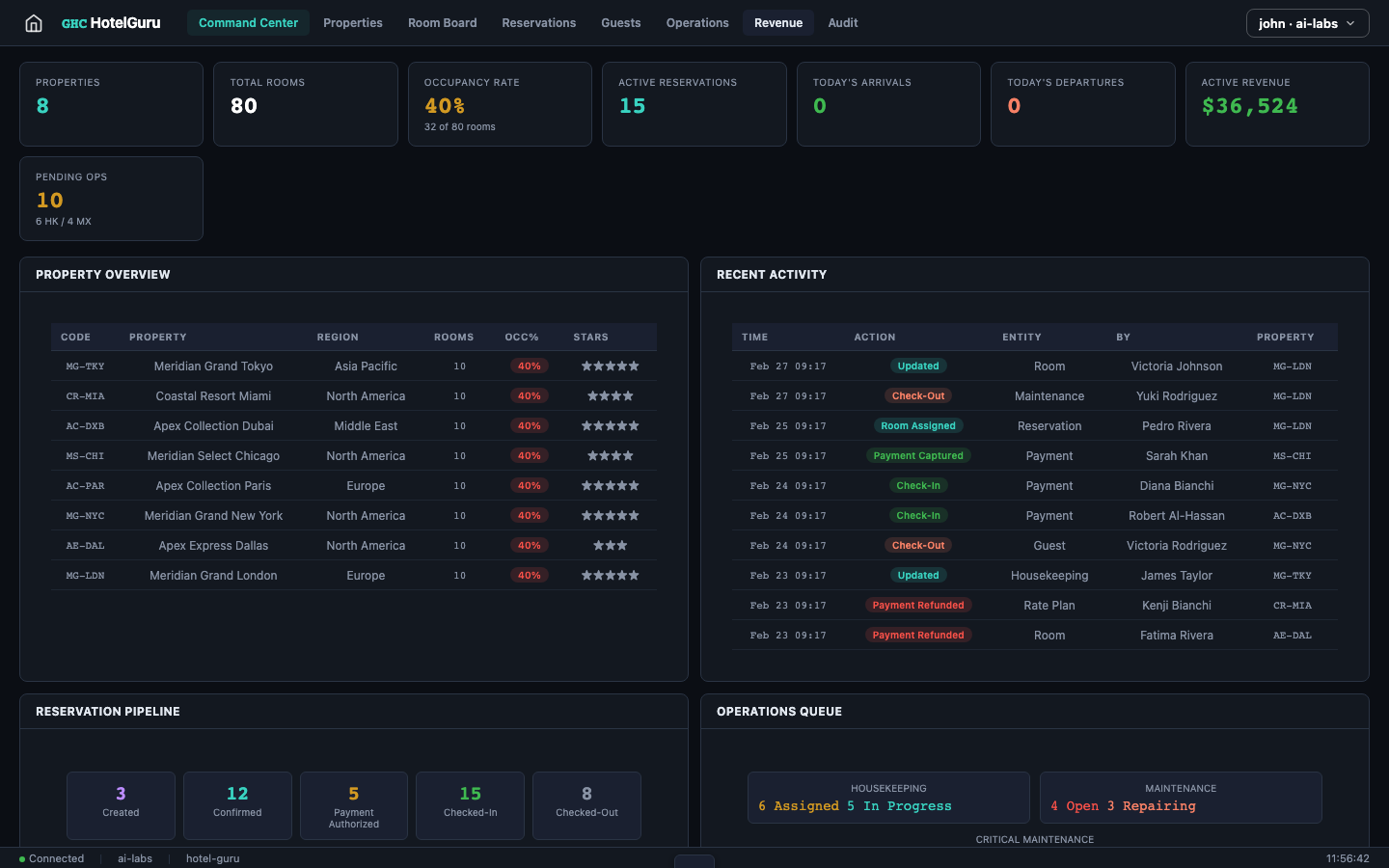
Example application HotelGuru, a multi-property operations app built on Kinetic, shown with sample data. Explore HotelGuru

HotelGuru command center: counts of 8 properties, 80 rooms, 40% occupancy and 10 pending operations tasks, a property list from Tokyo to London, recent activity such as room assignments and payments, a reservation pipeline and an operations queue for housekeeping and maintenance.
HotelGuru, an example application built on Kinetic. Sample data, not a customer deployment.

One guest complaint ends up in six places

A guest calls down at 11 p.m. about a cold shower. The front desk radios engineering, writes it in the log book and promises a call back. The night engineer can't fix it, so the room stays sold for tomorrow because nobody updated the PMS.

The next morning the chief engineer calls a plumber who isn't in the vendor master, so procurement can't raise a PO. The guest gets a credit at checkout that the front office manager never approved. And the general manager learns it was the third time this month only when the review goes online.

Multiply that by every property in a portfolio, each with its own PMS version and its own spreadsheet.

Where one guest issue lives today
  • Front desk log bookPaper
  • Engineering radio callNo record
  • Room statusPMS, not updated
  • Plumber's quoteEmail
  • Purchase orderProcurement system
  • Guest creditPMS folio, unapproved

Flagship use case

The same cold shower, run on Kinetic

One record follows the issue from the front desk to the guest folio. Each system is updated when the work happens, and a manager approves anything that costs money.

  1. Step 1 Experience layer

    The front desk logs it once

    The agent picks room 412 and “no hot water.” The guest name, stay dates and loyalty tier come from the PMS, so nothing is typed twice.

  2. Step 2 Workflow layer

    AI checks the room's history

    AI classifies the issue as plumbing and urgent, and notes that the same room had two hot water calls this month.

    AI step

  3. Step 3 Workflow layer

    Engineering gets the work order

    The on-shift engineer sees it on their phone with the history attached. If it isn't fixed within the hour, the duty manager is alerted.

  4. Step 4 Integration layer

    The PMS reflects reality

    If the room can't be fixed tonight, Kinetic sets it out of order in the PMS so it isn't sold again, and flags the guest for a room move.

  5. Step 5 Workflow layer

    The chief engineer calls in a vendor

    A recurring fault needs a plumber. Kinetic checks the vendor's insurance certificate is current and routes the purchase order for approval.

    Person approves

  6. Step 6 Integration layer

    The PO and the guest credit post

    The approved PO goes to procurement. The front office manager's approved goodwill credit posts to the guest folio in the PMS.

  7. Step 7 Experience layer

    The general manager sees the pattern

    Repeat issues by room and by property show up on one dashboard, which turns into a capital request instead of another night of complaints.

Other property workflows on the same connections

Reference architecture

How a hotel group's build fits together

This is a reference design, not a hospitality customer deployment. It runs one shared process across properties while each property keeps its own PMS.

  1. Experience layer

    Front doors

    • Front desk and department request form
    • Engineering mobile work queue
    • Manager approvals
    • Property and portfolio dashboards
  2. Workflow layer

    The shared process

    • One issue record per room or asset
    • Escalation by time and severity
    • Vendor and PO approvals
    • AI classification and repeat detection
  3. Integration layer

    Systems of record

    • Property management system
    • Procurement and ERP
    • Vendor master
    • HR and identity

Related result · Multi-location operator

Gracie Barra, 800+ locations on one platform

The martial arts franchise network replaced per-school tools with one Kinetic platform for memberships, payments and class schedules. Schools joined in phases, with no single cutover, and headquarters now sees membership and revenue across every location. Running many sites to one standard is the problem hotel groups have too.

Read the Gracie Barra case study

Deployment notes

  • Run Kinetic as a cloud service we host, or install it on your own infrastructure.
  • Staff at every property use the corporate identity provider, connected over SAML or OIDC.
  • Access follows role: a property sees its own requests, and a regional or brand team sees across properties.
  • Card payments stay in the PMS and payment systems. In this design Kinetic posts approved credits but never handles card data.

Frequently asked questions

Answered by Kinetic Data. Last updated .

  • Our properties run different PMS and ERP systems. Does that matter?

    Not for the process. Kinetic connects to each system through its API, so one workflow can serve properties on different systems. Any system that publishes an OpenAPI spec can be connected.

  • Does Kinetic replace our property management system?

    No. The PMS stays the system of record for rooms and folios. Kinetic reads room and guest details from it and writes back room status and approved charges.

  • Do guests need to download an app?

    No. Staff log guest issues today, and Kinetic can also publish web forms guests open from a QR code. Kinetic is headless, so a guest messaging channel or a Teams or Slack app is something you build against the Kinetic API.

  • Do you have hospitality customers?

    We have not published a hospitality case study. This page shows a reference architecture and an example application with sample data. Our closest published result is Gracie Barra, which runs more than 800 franchise locations on one Kinetic platform.

  • What does AI do, and what stays with staff?

    AI classifies issues and spots repeats. Staff approve purchase orders and anything that changes what a guest is charged. You choose the model, such as Claude or Azure OpenAI.

  • Where do hotel groups usually start?

    With engineering requests at one or two properties, because the volume is steady and the cost of a missed work order is easy to see. Vendor onboarding and guest recovery reuse the same connections.

Walk one property process through with us

In a free two-hour working session we take one process, such as engineering requests or vendor onboarding, map it across your PMS and procurement systems, and give you a written plan for building it on Kinetic.