Introduction
The BMC® Remedy® Action Request System® (ARS) is a platform for automating and managing business service management (BSM) processes. It draws heavily on ITIL®, the framework of best practices for IT service management and delivery.
BMC designed Remedy ARS to help large enterprises do three things:
- Replace manual systems with process automation
- Prototype, deploy, maintain and iterate service management applications quickly
- Capture and track business data
Hundreds of applications run on Remedy ARS: BMC’s own, applications customers write themselves, and products from third-party vendors, some of which build only for Remedy. They all share the Remedy development environment (which BMC calls “request-centric, forms-driven and workflow-based”), integration with Remedy ARS processes and its database, and its feature sets, commands and user interfaces.
BMC positions Remedy ARS within IT business service management, a framework for “managing IT from the perspective of the business.” IDC’s term for roughly the same idea is “services-centric” business process automation.[1]
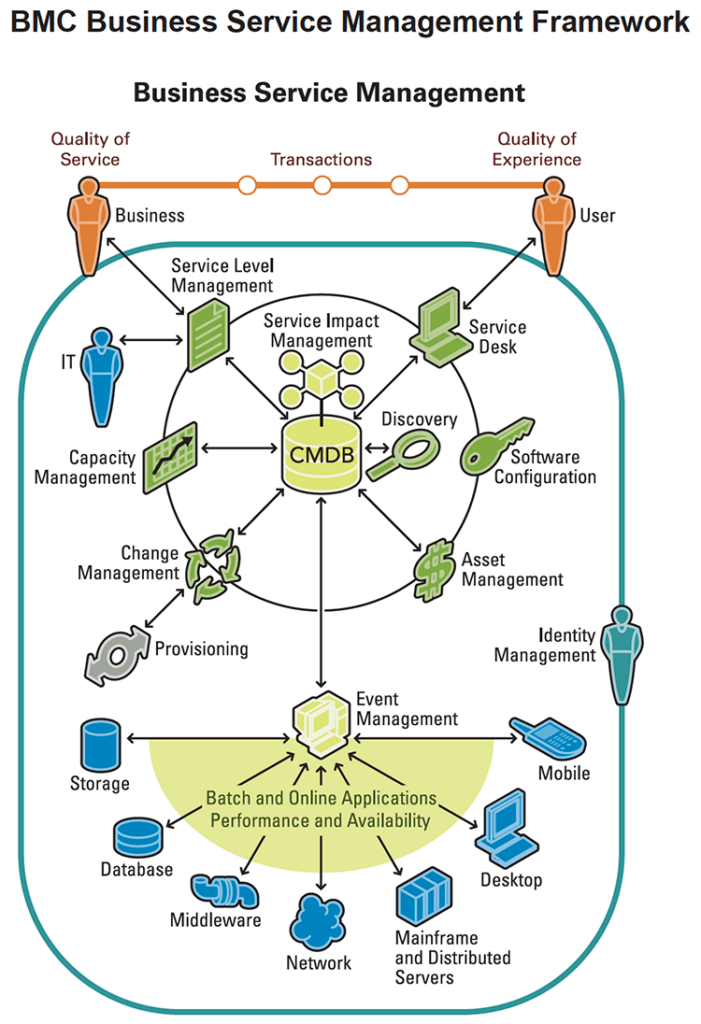
Remedy ARS is the foundation for BMC’s Atrium™ Configuration Management Database (CMDB), shown at the center of the diagram, and for the BMC IT Service Management suite around it, along with many service management functions built by partners and customers.
BMC Remedy ARS and enterprise feedback management
For as long as organizations have gathered customer feedback, the usual method has been the “single-use, hastily processed, quickly forgotten survey.”[2] Many businesses have been trying to replace stand-alone surveys with feedback systems that cover the whole enterprise. The goal is to make feedback useful for planning and process improvement, and to reduce what large businesses spend collecting it.
Organizations want one tool that meets the needs of every department that used to run its own surveys, and that standardizes survey methods and branding across the enterprise. It also has to consolidate results from different departments and feed them into existing data and analytics tools.
These tools now have a name: enterprise feedback management (EFM). A vendor in the market coined it, and analyst firms including Gartner and IDC adopted it. Gartner describes the market this way:
“Some vendors are beginning to appear in more than one traditional survey category, and a few vendors are seeing the promise of catering to all of these categories with a single tool, giving technology support to the field of Enterprise Feedback Management (EFM). By unifying survey activities, organizations can realize the cost efficiencies associated with leveraging one vendor across multiple departments and ensure that the task of conducting surveys (preparation and distribution of questions, collection and analysis of data) remains the same across the different functions.”[3]
Most EFM vendors design their products to integrate with CRM applications. Others stand alone and need custom integration work to reach enterprise applications.
Remedy ARS customers have another option in the platform they already run. Remedy already collects service and business process metrics, which are the core of any enterprise feedback database. What it needs is a native application that works with Remedy data, processes and workflows, so users can create surveys linked to Remedy transactions and events. Kinetic Survey is that application.
Where feedback fits in BMC’s service management model
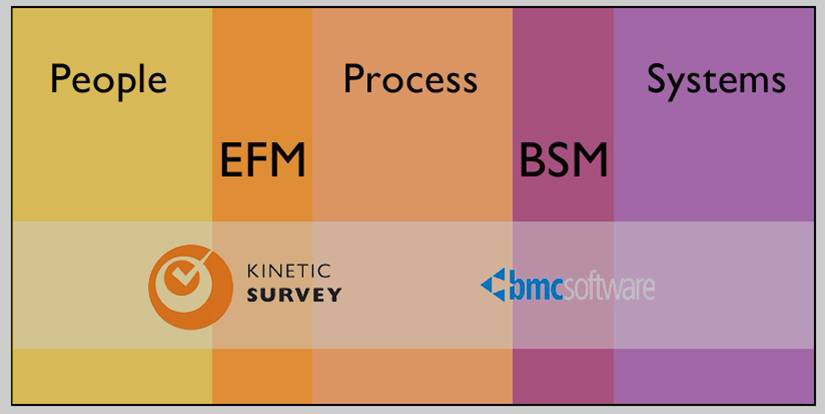
Kinetic Survey adds the people element, feedback from users, to the systems and processes BMC manages. It installs on the Remedy ARS server like any other Remedy application. Users build surveys into Remedy processes to measure quality of service and quality of experience, in service desk and incident management and in HR, product development, customer support and other areas.
Because Kinetic Survey uses the same databases, interfaces, reporting tools, and security and control features as other Remedy applications, it runs on resources the organization already has. Remedy administrators can standardize and control survey activity across the enterprise.
How Kinetic Survey works
Kinetic Survey integrates with any packaged or custom-built Remedy application.
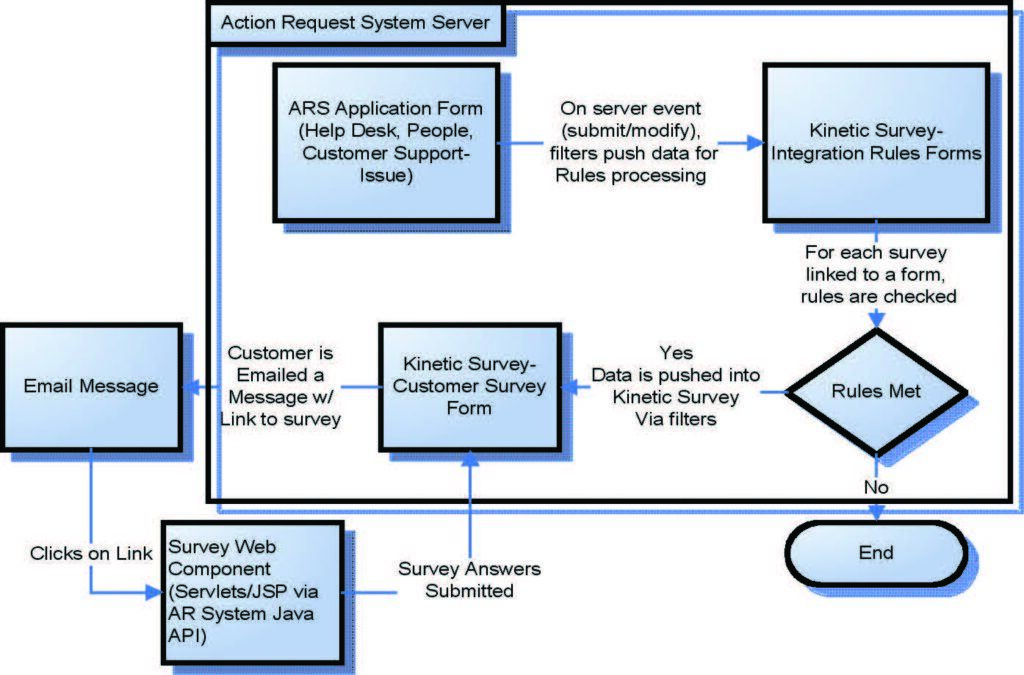
Integrating an application is a one-time setup of a few steps. After that, any licensed Kinetic Survey user can create rules that tie events in a Remedy application to one or more surveys. Users can also run one-time or scheduled batch surveys for campaigns, data validation and similar needs. Survey criteria and triggering events can be changed without code changes.
For each survey, Kinetic Survey stores basic information about the originating event: customer first and last name and ID, company name and ID, and up to five more attributes for reporting. It also stores the originating form and record ID, so reports can link back to the original record.
Surveys are triggered and filtered by configurable rules. When a group needs more than the rules provide, it can add functionality with its existing Remedy tools, staff and infrastructure. The shared workflow is designed to be extended, so additions follow a standard pattern.
Why build feedback on Remedy ARS
Remedy already holds the data
As a service management platform, Remedy already holds the service, process and compliance data needed to create, send and collect event-based and batch surveys for external and internal customers. What was missing was a feedback application built for the Remedy environment.
Shared IT resources
An EFM application built for Remedy uses the organization’s existing Remedy infrastructure and support. Kinetic Survey plugs into the Remedy environment without additional hardware, databases or middleware, and needs little training. Costs stay down because the methodology, security, training and documentation standards of the Remedy framework apply to surveys too.
Kinetic Survey also lets Remedy organizations enforce consistent branding and look and feel for surveys. That matters for large enterprises whose customers receive surveys that vary widely in format and quality.
More value from Remedy ARS
Many organizations use Remedy only for IT service management, though the architecture can do much more. Kinetic Survey gathers feedback from many sources, using the internal and external data integrations already built into Remedy, and tracks process improvement over time. Event triggers and batch options keep surveys timely and focused, and escalation options make sure feedback is acted on.
With Kinetic Survey, Remedy can support processes such as:
Market research
- Existing customer perceptions
- Prospect perceptions
- Competitive analysis
- Demographics
- Brand research
External customer satisfaction
- Post-service
- Post-purchase
- Partner and distributor satisfaction
- Product and service enhancement requests
- Short marketing surveys during incident and support interactions
Internal customer satisfaction
- Training
- Reviews
- Benefits administration
- Suggestion boxes
Product development
- Existing client needs
- Potential client needs
IT and ITIL-based service management
- Quality and timeliness of service delivery
- Continuous process improvement
ITIL compliance starts with documenting quality targets and responsibilities in service level agreements. Internal IT organizations also need to assess customer feedback and satisfaction regularly, another ITIL fundamental.[4] Kinetic Survey makes that assessment easy to show, because its results flow into Remedy reporting alongside data from CRM, HR and other systems.
As one analyst put it, for IT organizations, “It is all well and good to come up to scratch, even to perform above expectations, but it is not much good unless you can convey your competence to the powers that be.”[5]
Conclusion
Kinetic Survey was built natively on the BMC Remedy ARS platform. It lets organizations replace one-off surveys with an enterprise feedback program covering IT, market research, customer support, sales and marketing, HR and other areas, using the Remedy investment they already have.
Integration with other Remedy applications, packaged or custom, is a one-time setup. Remedy administrators control survey processes, feedback rules and security centrally, while people across the enterprise create and run their own surveys. Because Kinetic Survey uses Remedy’s reporting tools, survey results can be combined with Remedy data, including CRM, sales, HR and legacy data linked to Remedy.
Sources
- Dennis Byron, IDC white paper, “BMC’s Remedy AR System: A Services-Role Approach to BPA,” June 2005.
- Esteban Kolsky, Gartner, “Make the Transition from Surveys to Enterprise Feedback Management,” 2005.
- Gartner, ibid.
- Successful Delivery Toolkit, UK Office of Government Commerce.
- Mary Ann Maxwell, Managing Director, META Group.
BMC, Remedy and Action Request System are registered trademarks of BMC Software, Inc. Other names are the trademarks of their respective owners.